

Temperature Compensated Viscosity & Correlation: the key to process control

Viscosity challenges in process monitoring
Temperature compensated viscosity plays a key role in accurate process monitoring many processes & industries are familiarized with viscosity laboratory measurements. It consists of taking a sample from the process and measuring the viscosity () in a laboratory under very controlled and fixed Temperature (Reference Temperature:
) and shear rate conditions (
– usually low shear rate). When it comes to process viscosity measurement (
, the Process Temperature (
) fluctuates and is generally much higher than
. Additionally, the shear rate is generally higher. This is due to both the measuring principle and the process conditions. Therefore, considering the two parameters is crucial. Indeed, temperature is known to have a direct impact on viscosity. Additionally, products showing non-Newtonian behavior have a shear-dependent viscosity. For non-Newtonian fluids, the installation, the flow speed and agitation modify the fluid’s structural properties which impacts the fluid’s viscosity.
Process viscosity measurement often differ from laboratory results. This is due to different measurement conditions. Sofraser developed an innovative solution combining two well-known methods TCV at Reference Temperature and Correlation.
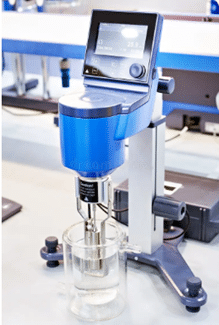
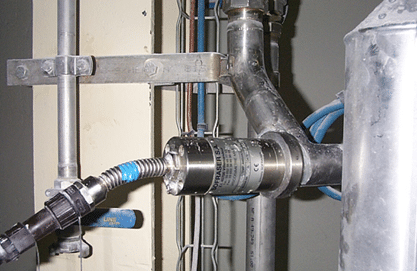
The two methods account for differences in measurement conditions. They compensate for them to provide an in-process viscosity value comparable to laboratory measurements.
Solution – Sofraser viscosity meters
1. MIVI process viscometer – Installation
Sofraser MIVI viscometers are versatile and suitable for a wide range of processes. They can be installed on batch or continuous systems, whether inline, online, or on reactors. The drawing below shows typical mounting locations and more are possible.

Methodology requires process temperature and viscosity measurements. The MIVI sensor provides both simultaneously.
2. The 9710 processor
TCV and correlation parameters are directly configured via the HMI of the Sofraser viscosmeter, using the 9710 processor.

Viscosity, Temperature, TCV, Density measurements are available through RS485 communication or 4/20 mA output signals.
Once configured, TCV and correlation are applied to the measured process viscosity. This ensures results comparable to laboratory measurements.
Step 1: Temperature Compensated Viscosity (TCV)
The methodology starts by compensating the effect of temperature on viscosity by calculating the Temperature Compensated Viscosity (TCV) at . In most cases,
is the temperature at which the laboratory viscometer is operated.
The 9710 uses the simplified equation described in the ASTM D341 standard. In order to determine the model’s parameters, the reference product’s behavior in terms of temperature must be known. Additionally, the model requires in-process Temperature & Viscosity measurements as well as a fixed Reference Temperature. Below is the curve Viscosity as a function of temperature for a sample of Cannon viscosity standard. It can be considered as the reference fluid and the data used to determine the parameter of the TCV mathematical model that will be set in 9710 processor.

Overall, TCV calculation provides the operator or user with a viscosity value that is not affected by the process temperature variations.
Step 2: Correlation
The TCV provides a viscosity at a fixed temperature (). It is now possible to work on the 2nd step of the methodology which is: building a correlation.
The objective of a correlation is to find a relationship between variables or two sets of data. In our case, the objective is to find a relationship/model between the laboratory measurement () and the Temperature Compensated viscosity.
One application of a correlation is to take into account the shear rate difference and correlate the laboratory measurement to the inline measurement with a viscosity value that is at the same temperature ().
For Newtonian fluids, a correlation is not necessary. Shear rate does not impact the viscosity measurement and calculating a TCV will provide a measurement that can directly be compared to the lab measurement.
Conclusion
By using temperature compensated viscosity and correlation, process measurements become fully comparable to laboratory results. The solution described in the article has been implemented by many Sofraser viscometers users in various industries. It is a good alternative to the use of a viscosity analyzers at reference temperature, which are complex and requires a higher investment. The ideal solution allows the inline process viscometer to deliver an information that is directly comparable to the reference values. In addition to taking the effect of temperature into account, the methodology also considers the difference of shear rate conditions. This solution can also be transposed to other physical quantities correlated with viscosity, thus extending its scope of application.
The methodology explain in this article was the subject of a presentation held by Mr. Stephane Millet at the ATC – Analyzer Technical Conference in Galveston (TX-USA) 2025.
Interested to learn more about the 9710 processor and the TCV feature: Easy Temperature Compensated Viscosity TCV Measurement