

Inline measurement vs Laboratory measurement: How to make the right choice?

In many industries, product quality relies on reliable measurements adapted to the process. Two main approaches exist: inline measurement, performed continuously during production, and laboratory measurement performed punctually and carried out on samples.
Both methods have advantages and limitations and are often compared. It is therefore essential to understand their differences in order to make the “right” choice.
What is Inline Measurement?
Principle of Inline Measurement
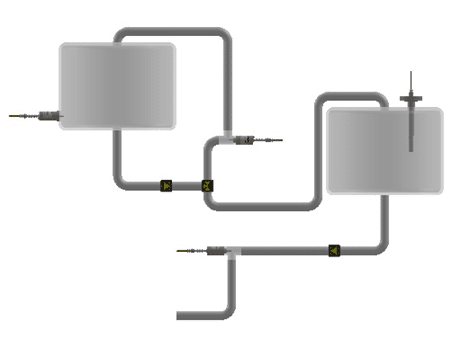
Inline measurement consists of analyzing a parameter in real time directly in the production line, using sensors installed on tanks or pipelines for instance.
The data is continuously available, allowing continuous monitoring of the process and its evolution.
Advantages of Inline Measurement
Inline measurement offers many benefits for the industry:
- Immediate responsiveness
Deviations are detected as soon as they occur. Operators can adjust parameters without delay, limiting drifts and production losses. - Process optimization
Data can be integrated into automated control loops, helping stabilize the process and improve product consistency. - Reduced operational costs
The absence of sampling and external analysis reduces handling, delays, and associated costs. - Improved product quality
Continuous monitoring helps maintain parameters within optimal ranges, reducing non-conformities. - Traceability and data management
Measurements are continuously recorded, making it easier to analyze trends, detect deviations, and implement predictive maintenance strategies.
Limitations of Inline Measurement
Despite its advantages, this method may be seen as uncomplete or with specific limitations:
- High initial investment
Equipment purchase, installation, and process integration may require significant investment, although the return on investment (ROI) is often very quick. - Sensitivity to industrial conditions
Temperature variations, vibrations, or fouling can affect the performance of some instruments. - Limitations for certain analyses
Some complex measurements or those requiring specific conditions cannot be performed directly inline.
What is Laboratory Measurement?
Principle of Laboratory Measurement
Laboratory measurement is based on analyzing a sample taken during production. This sample is transported and analyzed using standardized methods.
The results are then communicated to the production teams.
Advantages of Laboratory Measurement
This approach offers several benefits:
- High accuracy of results
Analyses are performed under controlled conditions, ensuring highly reliable measurements, especially for sensitive parameters. - Suitable for complex analyses
Laboratories can perform tests requiring specific protocols or sophisticated equipment. - Compliance with standards
Certain regulations require laboratory analyses to validate product quality. - Human expertise
Results are interpreted by qualified technicians who can identify anomalies and provide in-depth diagnostics.
Limitations of Laboratory Measurement
However, this method also has drawbacks:
- Longer response time
The delay between sampling and obtaining results can slow decision-making and impact process responsiveness. - Logistical and organizational costs
Sampling, transport, and sample management require time and resources. - Risk of sample alteration
The sample may change between collection and analysis, potentially affecting results. - Snapshot view of the process
Analyses reflect only a specific moment and may miss rapid or intermittent variations.
How to Choose Between Inline and Laboratory Measurement?
The choice depends on several criteria:
- Criticality of the measured parameter
Parameters that directly impact quality or safety should be continuously monitored—inline measurement is recommended. - Complexity of the analysis
Simple or repetitive analyses can be performed online.
Complex analyses requiring specific conditions remain within the laboratory domain. - Production volume and mode
For continuous or large-scale production, online measurement provides better control and profitability.
For occasional or low-volume production, laboratory measurement may be sufficient. - Regulatory constraints
Some industries require laboratory analyses—these requirements must be considered. - Overall economic analysis
It is important to compare the total cost of both approaches.
Online measurement requires initial investment, while laboratory measurement generates recurring costs.
Why Combine Inline and Laboratory Measurement?
In many cases, the best solution is to use both methods.
Online measurement allows real-time process control.
Laboratory measurement ensures validation of results.
This approach provides a good balance between responsiveness and accuracy.
Conclusion
Inline and laboratory measurements are not opposed—they are complementary.
The choice depends on industrial constraints, quality requirements, and production objectives. In most cases, combining both methods delivers the best results.