

The role of viscosity in sunscreen formulation: between protection and application

Every summer, millions of consumers apply sunscreens to protect themselves from UV rays. However, few people know that the quality, effectiveness, and even the pleasure of using these products largely depends on one physical property that is often overlooked: Viscosity. Viscosity can be defined as the fluid’s resistance to flow. It is a key characteristic for sunscreen products from manufacturing to use/application.
Understanding the viscosity of sunscreens
What is Viscosity and what is specific about sunscreen’s viscosity
Viscosity is a physical property that characterizes a fluid’s internal resistance to flow. In the case of sunscreens, Viscosity is influenced by the nature and concentration of the various components (emulsifiers, thickeners, UV filters, etc.) and by process conditions (temperature, mixing speed, mechanical stresses). Viscosity does not only determine the texture and ease of application, but also the stability of the emulsion and the homogeneous distribution of the protective active ingredients. Like many cosmetic products, sunscreens are non-Newtonian fluids that can exhibit shear-thinning, thixotropic, and yield stress rheological behaviors.

Why does viscosity directly influences the consumer’s experience and perception
Scientific studies show the close relationship between viscosity and the use/application properties of sunscreens and cosmetic product in general. From a consumer point of view, viscosity is a gauge of quality. A cream that is too fluid may be assimilated to a lack of efficiency. Whereas a product that it too thick/pasty may discourage the consumer to use it.
A sunscreen that is fluid will be difficult to condition, apply and the thickness of the layer applied on the skin may be too thin. A thick and viscous cream will be perceived as oily and unpleasant, difficult to apply and the thickness of the film may be unsightly.
Studies show that consumers will favor products that are a great compromise between ease of appliance and protection sensitivity. Viscosity directly influences both criteria but it also has an impact on waterproofness and on the resistance of the protective film.
A key parameter for stability, quality and industrial performance
Viscosity measurement in the process line is crucial to warrantee the stability, the texture and efficiency of the creams as well as to optimizing costs and batch reproducibility.
Sunscreens products are complex emulsions made of an oily phase and an aqueous phase. Both phases are stabilized using surfactants and thickeners. These polymers or natural gums, increase viscosity and help prevent phase separation. Measuring viscosity ensures that the emulsion remains stable over time and that the UV filters are uniformly dispersed, thus guaranteeing optimal protection.
Viscosity changes during each manufacturing stage, from the beginning to the end. It passes through characteristic values, and monitoring these values ensures that the preparation is proceeding correctly. A deviation in viscosity from the expected values indicates a problem. Monitoring viscosity allows the event to be detected and corrected.
Why and how to measure viscosity of sunscreens ?
Laboratory viscosity measurements : an essential but limited tool
In the absence of in-line viscosity measurements, it is the quality and reproducibility of the materials, as well as the rigor in executing the recipe or formulation, that allow each batch of cream to achieve the expected final quality. The final product’s quality is guaranteed by taking and analyzing samples in the quality control laboratory at the final manufacturing stage. Sampling is characterized by a significant turnaround time due to the time required for sample transportation and processing, the time needed to perform the analyses, and finally, the transmission of results to the production workshop. During this time period, production is suspended, and the production equipment cannot be used to manufacture the next batch. If the batch of cream is not put on hold, there is a risk of storing or packaging a non-conforming batch.
In-line viscosity measurement : a lever for Industrial Performance
With increasing demands for quality and reproducibility of manufactured products, the search for solutions to improve the productivity of manufacturing equipment, and the need for the most comprehensive production traceability possible, the implementation of online measurements represents a major advancement.
Indeed, sensors and analyzers installed directly on the manufacturing equipment (reactors, mixers, or pipelines for instance) provide continuous and instantaneous measurements from the beginning to the end of the production process. Traceability of each batch of product is detailed and complete. Furthermore, the very short response time allows for the rapid detection of any deviation in the manufacturing process and enables real-time adjustment of manufacturing parameters (temperature, stirring speed, thickener addition) to achieve the desired texture.
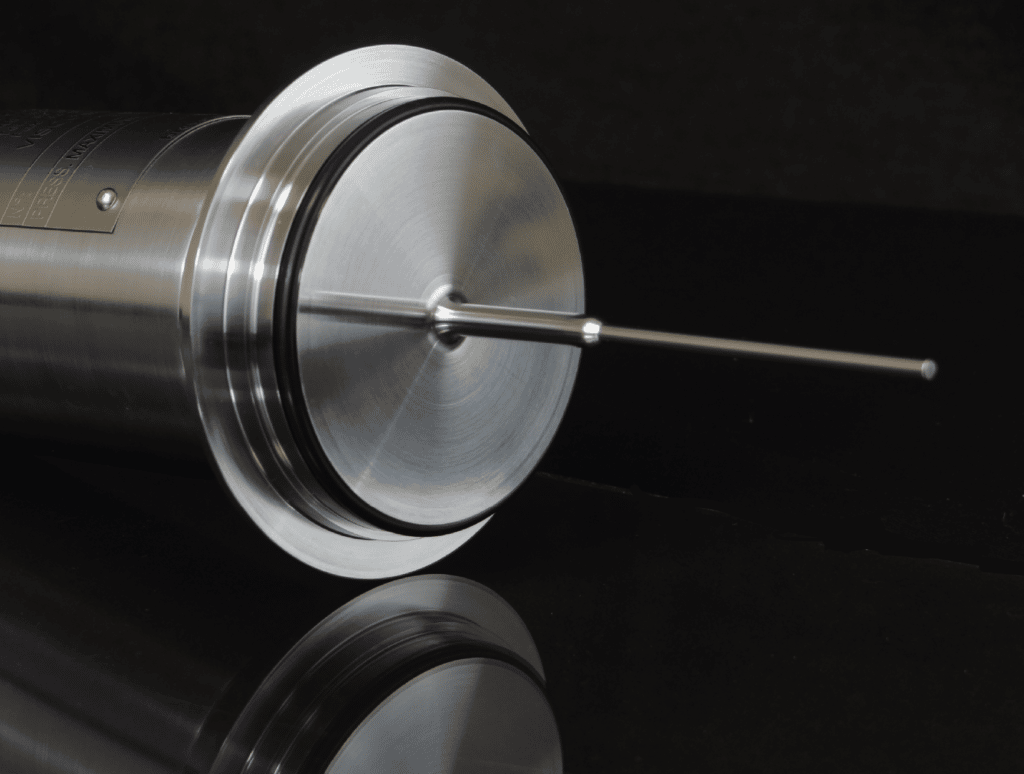
Sofraser Solutions : In-process viscosity measurement for the Cosmetic Industry
Sofraser viscometers are used in almost all industries over the past 50 years of presence. The Sanitary MIVI model and the EHEDG certified MIVI facilitate and improve the cleaning efficiency of the production unit between batches or at the end of the production period. The specificity of the two MIVI design is a major advantage for operators in the Cosmetic Industry and more precisely for sunscreen manufacturers.
Sofraser 9710 & 9720 processors have an integrated temperature compensation and correlation feature to provide a value that is directly comparable to the laboratory viscosity meters measured under lab conditions. The viscosity measurement provided by the MIVI viscometer is made at process temperature and under high shear rate conditions.
The data is then processed using the TCV feature (Temperature Compensated Viscosity), followed by a correlation with the laboratory measurement. The resulting viscosity value is directly comparable to a measurement performed in a laboratory environment, under laboratory conditions (low shear rate, at a reference temperature).
Mastering viscosity to warrantee performance, quality and product functionality
The precise and real-time viscosity measured by the Sofraser in-line MIVI Viscometer is beneficial on many levels optimized production time and conform product quality for sunscreen creams. The reduction of non-compliant batches and savings on raw materials also contribute to the return on investment and the improvement of overall yield.
On a daily basis, online viscosity measurement allows for the efficient production of product batches with the desired quality, satisfying users while ensuring their safety.