

Viscosity measurement : 5 mistakes to avoid in the industry
Why viscosity plays a key role in process efficiency
In many process industries, certain mistakes associated with viscosity measurement can have a significant impact. These mistakes directly affect the quality of the final product, plant safety, productivity and overall profitability. Discover the five most common mistakes and how to avoid them.
Why is viscosity so important for the industry?
Viscosity describes how a fluid flows when subjected to stress (gravity, Pressure, stirring…).
In industrial processes, Viscosity has a few different key functions:
- A direct Indicator of product Quality
It is the case for many products such as lubricants, oil, paints or inks, glues…) where viscosity is a part of a product’s specification for quality determination. - An Indirect way to monitor Process critical parameters:
In the Chemical or Food & Beverage Industry, Viscosity is often correlated to key parameters such as molecular weight of a polymer, concentration or even dry extract. - A parameter to monitor process efficiency
Viscosity directly impacts process efficiency for pulverization, dipping, combustion, heat transfer related applications for instance.
When viscosity is not measured, it often results in Quality drifts, higher raw material usage and end-product ending up not being conform. Here are the main mistakes we see in the industry.
Mistake n°1 : Not measuring inline Viscosity
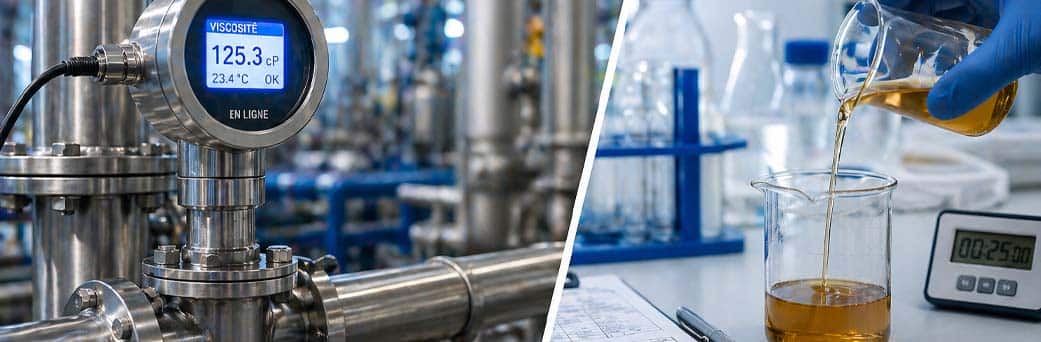
Performing laboratory measurements for viscosity monitoring remain a common way to monitor a process. However, relying on laboratory measurements only has some limitations :
- Sampling may be performed under dangereous process conditions (Temperature, Pressure or even product chemically unsafe),
- Time delay from sampling to receiving the laboratory measurements (from hours to days or even weeks)
- No continuous or live vision of the process.
A major risk
Noticing a drift after it happens, the product is already out of specification and there is no turning back. Between samplings, minutes or even hours of production may have passed. A viscosity drift during that time period may result in a relatively huge and costly product losses due to not conform end-product. This may lead to production and time loss or even product destruction.
The Solution
Inline viscosity monitoring, allows a continuous and real time viscosity control of the process. It offers technicians & operators the possibility to act before an event of viscosity drift, optimizing a process in real time, in the safest way possible.
Mistake n°2 : Incorrectly monitoring the Kinetic of a polymerization process
In polymerization applications, monitoring a reaction is a major challenge. A reaction:
- Too slow → Production performance is not optimized,
- Too fast → Loss of control, viscosity spike which often leading to solidified polymers in the reactor.
The two situations may lead to batch losses, long lasting shutdowns and even costly equipment damages.
The Solution
A process viscometer, providing a real-time, continuous and reliable information on the product’s quality and reaction kinetic. It is a key solution to ensure the safety of operations as well as to ensuring the quality of the manufactured polymer.
Mistake n°3 : Raw material overuse
Due to a lack of visibility, companies may try to compensate by adding raw material to ensure the final product’s quality.
This often leads to :
- An increase of production costs,
- Lower margins,
- Waste of raw material that may be costly.
The Solution
A precise and reliable in process viscosity measurement that allows for a better raw material usage during manufacturing. By following the « right recipe », it is possible to reach the highest quality standard at the right cost.
Mistake n°4: Installing a sensor that is not precise or reliable enough.
Each viscometer is unique. In an industrial environment with relatively harsh process conditions (line working 24/7, high Temperature, High Pressure), repeatability and precision of a sensor are key characteristics.
- Not repeatable → unreliable data set and unnoticeable drifts.
- Lack of sensitivity → Leads to the incapacity of detecting small variations that may be critical to ensure product quality.
The Solution
Relying on an instrument designed to remain precise and that is able to detect small viscosity variations over a long period of time, even in narrow viscosity ranges.
Mistake n°5 : Installing a sensor that is not robust enough
The reliability of a process instrument is essential: reliability and robustness often come as a pair. It lies in the instrument’s capacity of remaining stable over time without generating a drift or without the need of maintenance even under harsh process conditions.
Technologies involving mechanical or moving parts are often subject to:
- Mechanical wear,
- Drift over time,
- Need for periodic recalibration
- Production shutdowns.
The Solution
Sensors without moving parts based on the «Vibration at Resonance Frequency working principle ensuring a high level of performance and low maintenance even in the harshest process environments (up to 300 °C, up to 1000 bar) highlighted by the 7 years warrantee image of the long and trusted lifetime of the sensors.
A quick Return On Investment
Integrating a process viscometer represents an investment starting at 5,000€ for the simplest cases, with, in most cases, a return on investment of less than 6 months thanks to:
- Improved control of the process
- Waste reduction,
- Waste and Energy management,
- Increased efficiency,
- Descrease of unplanned production shutdowns
Recap
Viscosity is a key parameter for most industries and many applications.
Continuous and real time viscosity measurement allows to:
- Improve a final product’s quality,
- Increase process reliability,
- Reduce production costs,
- Increase the global performance of operations.
By avoiding those 5 mistakes, inline viscosity measurement becomes a true lever for industrial optimization.